Balancing tryptophan is not only about mood and sleep. It can also switch back on a natural defence system that calms brain inflammation and protects the brain’s barriers. This is not fringe science but a real system that research is only starting to map. Children with autism and PANS need this protection, yet they lose it when tryptophan is pulled off course.
When One Amino Acid Holds Your Child’s Brain Hostage
Imagine your child changing overnight after something as ordinary as an infection. One week they are laughing and sleeping, the next they are terrified, raging, and unable to rest. Parents of children with autism or PANS know this cycle too well. Crashes like these can have many triggers – immune flare, inflammation, gut issues, genetics. But one factor keeps appearing: how the body processes tryptophan.
Tryptophan is an amino acid from food that the body turns into brain chemicals, sleep hormones, and immune signals. When this process is disrupted, a stable child can quickly shift into chaos.
The Traffic Jam Inside the Body
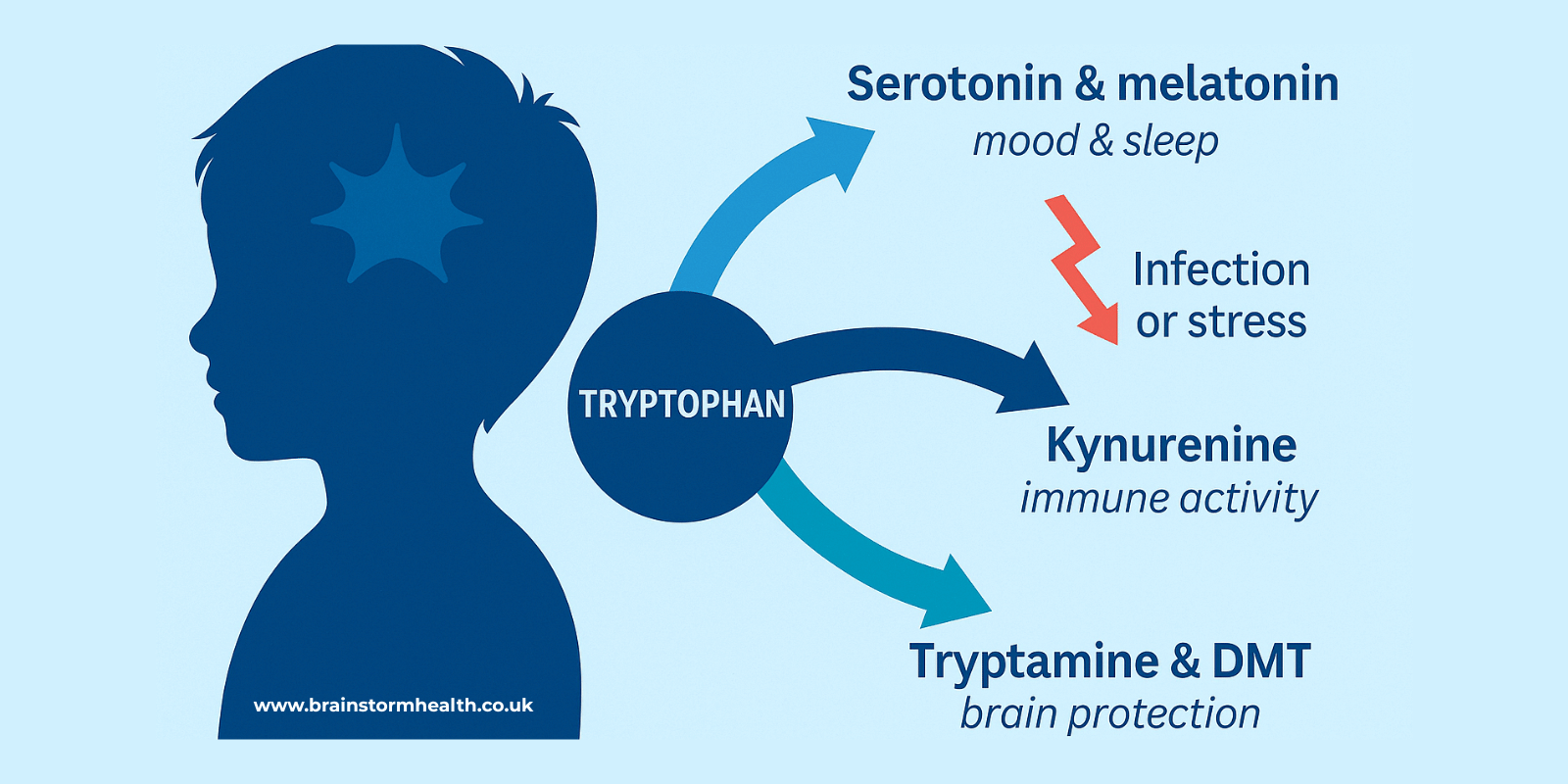
Tryptophan has three possible jobs in the body:
– To make the chemicals that control mood and sleep.
– To make the chemicals that switch on the immune system.
– To make the chemicals that protect the brain from overload.
When a child gets sick or stressed, the body diverts most of the tryptophan into the immune system track. That means less fuel for mood, sleep, and brain protection. Parents see the fallout: a child who jolts awake in the night, sweats through pyjamas, panics at tiny sounds, explodes over nothing, or crumbles after eating.
Why Children Are So Vulnerable
Children are not small adults. Their brains are still wiring, their immune defences are unfinished, and infections strike often. Add gut problems or genetic weak points and the system tips faster. Some gut bacteria even steal tryptophan or twist it into chemicals that drive anxiety or stomach pain. What seems like a small trigger in one child can cause a full crash in another.
How to See What’s Happening
The good news is this imbalance can be measured. A simple urine test can show whether the chemicals for mood and sleep are running low or if the immune pathway is running too high. Another test looks directly at tryptophan and how it is breaking down. No needles, no stress, just clear numbers that explain the chaos you see at home. Some children show mood and sleep chemicals stuck low, others show immune signals pushed too high. Repeating the test shows if balance is returning.
What Can Be Done
You cannot make the brain’s protective chemicals directly, but you can support the system so tryptophan flows in healthier directions:
– Reduce inflammation from infections, allergies, mould, or autoimmunity. With less pressure on the immune system, tryptophan is less likely to be pulled off course.
– Support gut health so bacteria do not steal tryptophan or turn it into the wrong chemicals.
– Fill nutrient gaps like B6, B2, iron, and folate. These are the tools enzymes need to guide tryptophan the right way.
– Lower chemical stress in the body so brain pathways stay calmer and less fragile.
– Use repeat testing to see if balance is improving. This gives parents proof on paper as well as in daily behaviour.
The Overlooked Defence System
Takeaway
These regressions are complex and traumatic. But tryptophan balance is one piece we can measure and influence. Restoring it may help children keep hold of calm, sleep, and the brain’s built-in protections.
Cut the Clutter, Keep the Science – Weekly Insights
Sign up free
IMPORTANT
The information provided in this article is for educational purposes only and is not a substitute for professional medical advice, diagnosis, or treatment. Always consult with medical doctors or qualified functional medicine practitioners before introducing any new supplement or intervention.
Concerned about your child’s health? We’d love to have a chat with you.
References
Boccuto, L., Herman, H., Cook, S., Delogu, T. et al., 2013. Decreased tryptophan metabolism in patients with autism spectrum disorders. Molecular Autism, 4(1), p.16. PubMed Central
Golubeva, A.V., Joyce, V.D., Moloney, F. et al., 2017. Microbiota-related changes in bile acid & tryptophan metabolism are associated with gastrointestinal dysfunction in a mouse model of autism. EBioMedicine, 24, pp.166–178. ScienceDirect
Morales-Garcia, J.A., Peñafiel, A.J., Blanco, R. et al., 2020. N,N-dimethyltryptamine compound found in the brain of mammals has a role in the sigma-1 receptor. Translational Psychiatry, 10, 124. Nature
Nardai, S., Szabo, A., Kovacs, F. et al., 2020. N,N-dimethyltryptamine reduces infarct size and improves outcome via sigma-1 receptor dependent mechanisms. Experimental Neurology, 329, 113309. ScienceDirect
Szabó, A., Kovács, K., Frecska, G. et al., 2021. N,N-Dimethyltryptamine attenuates spreading depolarization via sigma-1 receptor activation. Neuroscience Letters, 756, 135961. ScienceDirect
László, M.J., Ollikainen, B., Harju, M. et al., 2025. N,N-dimethyltryptamine mitigates experimental stroke by supporting neuronal resilience and vascular integrity. Science Advances, eadx5958. Science.org
Aziz-Zadeh, L., Smith, D.A., Wang, J. et al., 2025. Relationships between brain activity, tryptophan-related metabolism, and behavior in neurodevelopmental disorders. Nature Communications, 16, 58459. Nature
Santana-Coehlo, D., Venediktova, L.M.M., et al., 2024. Does the kynurenine pathway play a pathogenic role in autism spectrum disorders? Journal of Neuroinflammation, 21, 1170. ScienceDirect
Cheng, D., Lei, Z., Chu, K. et al., 2024. N,N-Dimethyltryptamine ameliorates Alzheimer’s disease by restoring neuronal Sigma-1 receptor–mediated ER–mitochondria crosstalk. Alzheimer’s Research & Therapy, 16, 95. BioMed Central